Smart Security for Small Businesses: A Starter Guide
Protect your small business without breaking the bank or signing long contracts. This practical guide covers the essential smart security setup for LA business owners.

Elena Torres
Security Systems Consultant
Elena advises property owners on practical security upgrades. She specializes in no-contract, self-monitored systems for apartments and homes.
Smart Security for Small Businesses: A Practical Starter Guide
Running a small business in Los Angeles comes with plenty of rewards — and a fair share of risks. Whether you operate a boutique, a home-based studio, a co-working space, or a retail shop, protecting your assets, employees, and customers is non-negotiable. The good news? You don't need an expensive professional monitoring contract or a complex hardwired system to get serious protection. Modern smart security devices make it easier — and more affordable — than ever to build a reliable setup from the ground up.
This guide walks you through exactly what a small business needs to get started with smart security, what devices matter most, and how to think about your space strategically.
Why Smart Security Makes Sense for Small Businesses
Traditional security systems often come with hefty installation fees, long-term monitoring contracts, and equipment that's difficult to move or modify. For small business owners — especially those leasing commercial space — that kind of commitment isn't always practical.
Smart security devices solve this by offering:
- Flexible, no-drill installation options that won't damage leased walls or doors
- No monthly subscription fees, so your protection costs don't compound over time
- Remote monitoring from your smartphone, whether you're on-site or across town
- Scalability — start small and add devices as your needs grow
For LA business owners dealing with everything from package theft to break-ins, having eyes and alerts on your property 24/7 is no longer a luxury — it's a baseline.
Start at the Entry Points: Locks and Doorbells
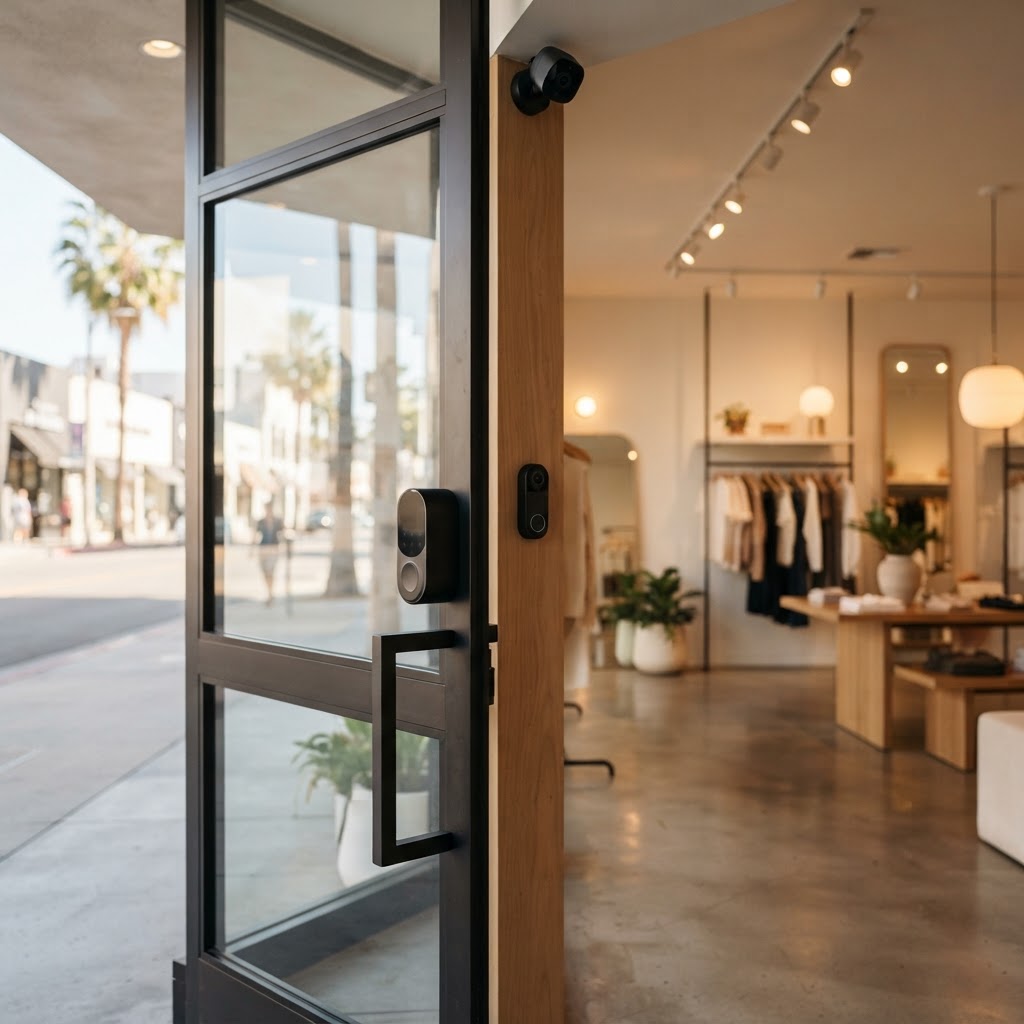
The front door is the first line of defense for any business. A smart lock gives you keyless access control, which means no more copying keys for employees, no locksmith calls when someone leaves the team, and a complete access log you can review anytime.
Cryptronics smart locks are designed for easy installation — no professional needed — and support temporary access codes ideal for cleaning crews, contractors, or part-time staff. When someone's role changes, you simply remove their code. It takes seconds.
Pair your smart lock with a video doorbell to see and speak with anyone who approaches your entrance, even when you're not on-site. Video doorbells provide motion-triggered recording and two-way audio, so you can screen visitors, deter solicitors, and keep a visual record of everyone who comes and goes.
Why this matters for small businesses:
- Eliminate physical key management headaches
- Create accountability at entry points
- Deter opportunistic theft before it happens
Cover Your Space: Cameras and Sensors
Once your entry points are secured, the next step is visibility inside and around your business. Smart cameras placed at strategic positions — near registers, storage areas, back doors, and parking areas — give you continuous awareness of your space.
Cryptronics cameras offer HD video, night vision, and motion alerts sent directly to your phone. There are no ongoing cloud storage fees eating into your budget. Mount them on shelves, countertops, or use adhesive mounts where drilling isn't an option.
For doors and windows you can't always monitor visually, door and window sensors are a low-cost, high-value addition. These small devices alert you the instant an entry point is opened unexpectedly — after hours, on weekends, or whenever you're away. They're discreet, battery-powered, and install in minutes.
Recommended camera and sensor placement for small businesses:
- Main entrance and rear exit
- Point-of-sale or cash handling areas
- Storage rooms or inventory areas
- Parking lot or exterior walkways
- Windows accessible from ground level
Don't Overlook Environmental Hazards
Security isn't only about unauthorized people — it's also about protecting your physical space from environmental threats that can shut down your business unexpectedly.
Smoke detectors are legally required in most commercial spaces, but smart smoke detectors go further by sending mobile alerts the moment smoke or heat is detected, even if no one is present. That early warning can be the difference between a contained incident and a total loss.
Water leak sensors are equally important, especially in spaces with kitchens, bathrooms, or utility rooms. A slow leak behind a cabinet or under a sink can cause thousands of dollars in damage before anyone notices. Place Cryptronics water leak sensors near water heaters, sinks, and any plumbing access points for around-the-clock monitoring.
These devices are often overlooked in a basic security plan, but for small business owners, they're some of the highest-ROI devices you can add.
Managing Power and Protecting Equipment
One final — and frequently underestimated — layer of small business security is power management. Smart power strips let you monitor and control the power supply to your equipment remotely. Did you leave a device on overnight? You can shut it off from your phone. Want to cut power to non-essential equipment after hours to reduce fire risk and energy waste? Done in seconds.
For businesses with valuable electronics — computers, displays, point-of-sale systems — smart power strips also provide surge protection, adding a quiet but meaningful layer of hardware security.
Building Your Security Plan: Practical Next Steps
Getting started doesn't have to be overwhelming. Here's a simple framework:
- Map your entry points — every door, window, and access point that someone could use to enter your space.
- Identify your blind spots — areas where you have no current visibility or monitoring.
- Prioritize high-value zones — where your inventory, cash, or sensitive equipment is stored.
- Add environmental monitoring — at least one smoke detector and water leak sensor in relevant areas.
- Test everything — verify alerts reach your phone and cameras record correctly before relying on the system.
All Cryptronics products come with a 2-year warranty and a 30-day return policy, so you can build your setup with confidence and adjust it as you learn what works best for your specific space.
Conclusion
Smart security for small businesses doesn't require a massive budget, a professional installer, or a long-term contract. With the right combination of smart locks, cameras, sensors, and environmental monitors, you can build a genuinely effective security system tailored to your space — and manage it all from your phone.
Whether you're locking down a single-room studio or a multi-area retail shop, starting with the fundamentals and scaling from there is the most practical approach. Your business deserves protection that's as flexible and hardworking as you are.